|

|
werc
hometown: los angeles, ca
website: www.crolvswerc.com
Albus Cavus: Tell us about your background... How did you end up in LA?
Werc: I was born in Cd. Juarez and grew up in El Paso. We moved there when I was 8 years old. I started writing around 92', and left El Paso for good around 97'. After that I hopped around to Albuquerque, Dallas, and San Diego. Moving to Los Angeles was the most unplanned move to date. I had been thinking about transitioning into a job where I could use my creative skills, like design. Sure enough, I got a phone call from a friend asking me if I'm looking for a job, that his firm is looking for someone, and he puts in the good word. I got the job, moved, and found out that Los Angeles feels more like home than any other place I have lived in.
AC: How did you get into arts? Did you go to art school?
W: The streets where my training grounds. When I started writing there were really no visible signs of graff in El Paso. On the way to school one day, I ran into an old friend who asked if I wanted to go write. We went to a ditch, got the download on a pen name, and I came up with one on the spot. I remember questioning why they were doing it in a ditch if no one could see it, and the answer was that it was for practice only. I laughed.
AC: So that's how you came up with Werc? Why Werc?
W: Ha, no it didn't come up right there and then. I went through quite a few names before that. Glue is what I wrote before Werc. I really liked "g" and the "e" letters. Werc as my name came at the same time that Crol and I started working together. Before we were friends we were enemies. When we befriended each other, Crol was talking smack about my name and how there were like 10 other Glues in LA and other places. So we shot the shit about other names, and he explained how before Crol it was Crow and before that it was Krow. Krow backwards is Work, but I wasn't feeling the "o" and the "k" was played out so I came up with Werc. In turn, we got the idea of doing the Werc-vs-Crol competitive partnership, like a continuous battle since we used to have beef. It became another form of motivation to push each other.
AC: And now you are a professional artist. What does your typical day look like?
W: To me a professional artist is simply someone who gets paid to do what they do, and getting paid is just a byproduct of doing the work they love. Most days I'm working; I'm a workaholic. Really, that can involve painting a wall or a panel, designing for myself, doing freelance designs, research, e-mails, meetings, cafe, chips and salsa, spending too much time on the internet, hunting and gathering, planning, and producing.
AC: You are hunter and gatherer. Is that a part of your artistic process?
W: I use found objects and incorporate a lot of cardboard into my paintings. I'm drawn to logos, either because of their multiple meanings or because it's something I'm familiar with. Collage is a big part of my work and may involve found objects, plexiglas, paper, nails, or anything that is relevant to the piece I'm making. Often times the object I find is what dictates what the piece will be about. In that sense, I work with what I find. I try to leave the logos intact and carefully paint around them. When it comes to graff pieces, I usually just freestyle.
AC: Why cardboard?
The idea to use cardboard in my pieces comes from my childhood. The Juarez neighborhood I grew up in was divided by class; on one side there were average two story houses and just across the street were houses made of cardboard, palettes, roofing scraps, and sometimes cinder blocks. Most of my friends lived on that side, but I never noticed the difference between their houses and mine. Forward 15 years later as I'm looking at an image of the cardboard houses in Cd. Juarez and realizing that they are insulated with cardboard shipping boxes stamped with logos from multi-national conglomerates. As if they can't escape it, our people are forced to migrate because these companies move in and take over the land. These campesinos end up on La Frontera and though most try to come to the states for better opportunity, many end up working on the maquiladoras for the same people who drive them out of their land. As if that weren't enough, they must return to a home covered with cardboard shipping boxes.
AC: You are so tightly connected to these themes that they constantly reoccur in your work?
W: I focus on cultural border phenomenon and related ideas. Although not all my pieces involve that, it is a prevalent theme throughout my work.
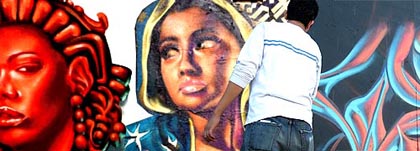
AC: The portraits of workers, farmers and prostitutes capture their daily lives in a very intense way. The beautiful faces over the background of found materials tell the stories of being stuck on their side of the cultural border. Which side of the border do you stand on when you paint them?
W: "Ni de aqui, Ni de alla" which translates to "Neither from here, nor there." I stand on neither and both, because that is what I know.
AC: Is it just for you to archive our current cultural experience or is there something more you want your audience to learn from these paintings?
W: I think by default the cultural experience is archived no matter what, but it is not necessarily my intent. Beyond that any painting can be perceived in many ways, and you take with you whatever that is that you make a connection with. It’s like when people tell me that they can't read the piece I just painted and they don't see the letters; I explain to them that they have to see it for what it is; an abstract piece, with color, shape, form, and whatever personal connection you have with it. In that same way, my paintings are like that, even though they are representational, they are abstract in thought.
AC: Where do you get your inspiration?
W: For me there's no particular source of inspiration. I get inspired by everything that I see around me, be it driving down the street, a piece of trash, friends, a tag, a doodle, - it's endless. I draw on childhood memories, moments, and current social and political events. Ultimately, I have the urge to create.
AC: What do you like more? Working on walls or canvasses?
Not to sound like a parent, but I love them both the same. Painting a panel takes more time on most occasions, but if I'm not painting walls it drives me insane. When working on a panel I get to work more with collage and found objects. Painting a mural requires you to use your whole body to move and make lines that are 10 feet long, and you can't do that on a small panel. When you paint a wall or public space, you relate it in a whole different manner. Art in public space is as much about the environment as it is about the subject. Recently I have started working on large scale pieces that allow me to merge both.
AC: Why public spaces? What responses do you get on the streets?
Art in public spaces is for the people; everyone has access to it and it's free. It makes you identify with the space you're in; it can become a landmark; it becomes part of a community; it creates a sense of community; it provokes thought and combats the tons of garbage we see on billboards and sides of buildings throughout the city.
I think the responses have changed in the time I've been painting. I remember one time almost getting run over by a truck that literally turned the corner and went on the sidewalk at 40 mph while the driver screamed, "get a life!" There's a whole gamut of reactions, but most of the time they are positive. Another time a lady who stood in front of the wall we had just painted, started crying. Sometimes, the people from the neighborhood are so grateful that they bring us food, drinks, and ask how they can be a part of it.
|
|
|